B2B marketing is facing specific challenges ...
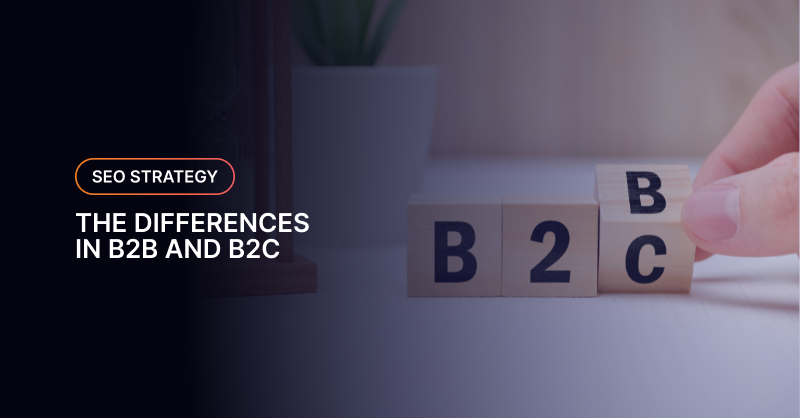
B2B SEO vs B2C SEO: Differences, Strategies and Best Practices in 2026
2 Jul 2026
Table of contents
You're doing SEO. But are you doing the right SEO?
A B2B SaaS company and a B2C e-commerce brand can both want to rank on page one of Google. But if they follow the same SEO playbook, one of them is going to fail — not because SEO doesn't work, but because they borrowed an approach built for someone else's reality.
In B2C, you're optimizing to win over one person in seconds. In B2B, you're optimizing to guide a buying committee over several months. Same playing field, fundamentally different rules.
And with the rise of AI answer engines like ChatGPT, Perplexity, and Google AI Overviews, this distinction matters more than ever. GEO (Generative Engine Optimization) looks completely different when your audience is a CTO evaluating three vendors versus a consumer searching for running shoes.
In this article, we break down the key similarities, the critical differences, and the concrete strategies that actually work, whether you're operating in B2B or B2C. Whether you're building your first organic strategy from scratch or refining an existing one, you'll walk away with a clear framework for making smarter decisions.
At Momentumm, our SEO and GEO agency in Montreal works with companies on both sides of the equation. And what we see every day is that the best results come when SEO strategy is aligned with a client's commercial reality, not with whatever generic trends are circulating online.
What Is B2B SEO? And B2C SEO?
At its most basic, SEO is about optimizing your online presence to show up at the right moment, in front of the right person, on search engines. Simple enough. But that definition glosses over a much more nuanced reality once you start asking who that person actually is and why they're searching.
B2B SEO: reaching professionals in research mode
B2B SEO (Business-to-Business) refers to the optimization strategies used by companies that sell products or services to other businesses. Management software, consulting firms, industrial equipment, marketing agencies — if your customer is an organization rather than an individual, you're operating in B2B territory.
What fundamentally sets B2B SEO apart is the nature of the buyer. They're not searching on impulse. They're searching because they have a business problem to solve, a budget to justify, and colleagues to bring on board. Their queries are long, precise, often technical. They compare options. They come back. They download your white paper on a Tuesday, attend your webinar a month later, and maybe sign a contract six months after that.
|
Key characteristics of B2B SEO:
|
B2C SEO: capturing a consumer's attention in the moment
B2C SEO (Business-to-Consumer) targets individuals buying for themselves or their household. Clothing, electronics, travel, food, online subscriptions, the spectrum is massive, but the logic stays the same: reach the right consumer at the right point in their buying journey, which is often very short.
The B2C buyer is emotional, reactive, and persuadable. They can search "best running shoes 2025" in the morning and check out by evening. B2C SEO has to be optimized for speed of conviction, traffic volume, and a frictionless path to conversion.
|
Key characteristics of B2C SEO:
|
What do B2B and B2C SEO have in common?
Before diving into the differences, there's a truth worth stating upfront that often gets lost in the B2B vs B2C debate: the foundations of SEO don't change. Regardless of your industry, Google evaluates your site using the same core criteria. Here's what stays universal.
Technical foundations
A slow, poorly indexed, or error-ridden site will underperform; B2B or B2C, no exceptions. That's why web design and SEO need to be planned together from the start. Core Web Vitals, URL structure, internal linking, redirect management, robots.txt, XML sitemaps: all of it applies equally in both worlds.
For a long time, B2B companies got away with outdated websites on the premise that "our clients don't search on Google." That era is over. A CTO evaluating a vendor goes through the web like everyone else, and if your site takes six seconds to load, they're already on your competitor's page.
The importance of content
Google and AI engines reward content that genuinely answers user questions. That principle holds in both B2B and B2C. What changes is the type of question and the expected format of the answer. But the bar for quality, depth, and relevance stays the same.
A sloppy blog post won't rank, and a product or service page that skips the details won't convert.
E-E-A-T principles
Google works to identify trustworthy, legitimate sources across every industry. To be credible in the eyes of both search crawlers and your prospects, you need to demonstrate that you know what you're talking about, that you have real hands-on experience, and that your site is worth trusting.
In practice, that means:
- Named authors with bios and genuine expertise
- Cited, verifiable sources
- Client testimonials, certifications, awards, and mentions in recognized media
- UA secure site (HTTPS) with complete legal pages
Netlinking
Earning links from recognized third-party sites remains one of the most powerful trust signals for Google, in B2B and B2C alike. The strategy to get there may differ (specialized PR in B2B, influencer partnerships in B2C), but the objective is the same: build domain authority so your site is seen as a credible reference.
User experience
Smooth navigation, logical site architecture, clear calls to action, a flawless mobile experience, all of it matters just as much to a B2B buyer as it does to a B2C consumer. Google tracks behavioral signals. If people are leaving your site within 10 seconds, it doesn't matter what industry you're in: that's a negative signal.
To summarize, B2B and B2C SEO share the same technical and editorial foundations. What sets them apart is the strategy built on top of those foundations: the keywords you target, the content formats you prioritize, the conversion cycles you optimize for. That's exactly what we dig into in the next section.
What are the key differences between B2B and B2C SEO?
Target audience and decision-making journey
This is the starting point of any serious SEO strategy: who is searching, and how do they decide?
In B2C, the answer is relatively straightforward. An individual feels a need, does a bit of research, compares quickly, and buys. The decision is entirely theirs. Their journey is short, often emotional, and sometimes impulsive. You have a narrow window to convince them, and your SEO needs to account for that.
In B2B, the reality is radically different. A typical B2B purchase involves an average of 6 to 10 decision-makers within a single organization. Think of the CTO evaluating technical feasibility, the CFO approving the budget, the operations director assessing the impact on their team, and the CEO signing off. Each has their own questions, their own criteria, and potentially their own Google searches.
What this means concretely for your B2B SEO:
- Create content that answers the questions of each decision-making profile
- Structure your site with solution pages and industry pages that speak to the specific challenges of each stakeholder
- Never assume a single piece of content will be enough to convince the entire committee
In B2C, you convince a person. In B2B, you convince an organization.
The sales cycle and its impact on your content funnel
A direct consequence of that multi-stakeholder dynamic: the time it takes to close a B2B deal is incomparable to B2C.
In B2C, the cycle can be measured in minutes. In B2B, it's common to see 3 to 18 months between the first organic touchpoint and a signed contract. That's not a flaw in the process; it's a reflection of the financial and organizational risk involved.
For SEO, this changes everything about how you build your content funnel.
In B2C, the funnel is short and direct. A discovery piece, an optimized product page, a well-structured review section, and the path to checkout is set. SEO needs to maximize fluidity and remove any friction between the search and the purchase.
In B2B, the funnel is long and multi-layered. You need content for every stage:
- Awareness (educational articles, industry guides, explainer videos): the buyer recognizes they have a problem
- Consideration (comparisons, case studies, white papers): they evaluate the available solutions
- Decision (client testimonials, ROI calculators, demos): they choose a vendor
- Validation (references, certifications, reassurance content): they justify their choice internally
A B2B buyer may consume 7 to 13 pieces of content before ever contacting a sales rep. If your SEO only covers the top of the funnel, you're invisible at the moments that actually matter.
Search intent
Search intent is the underlying reason behind a query. And it differs fundamentally between B2B and B2C, largely because the sales cycle shapes how people search.
In B2C, intent is mostly transactional or navigational: "buy men's trail running shoes," "best coffee maker 2025," "pizza delivery Montreal." These queries signal a clear, immediate purchase intent. B2C SEO needs to be optimized to capture that intent at the right moment and move the user toward conversion as quickly as possible.
In B2B, intent is mostly informational or comparative: "how to reduce employee turnover," "difference between ERP and CRM," "best project management software for distributed teams." The B2B buyer is in active research mode. They're building their understanding of the problem before they even start looking for a solution. They're comparing approaches, vendors, pricing models. Your SEO needs to support that thinking process, not push them toward a contact form after their first article.
Keyword volume vs. value
This is often where less experienced SEO strategists make their first mistake in B2B: confusing low volume with low opportunity.
Let's look at the numbers realistically:
|
B2B SEO |
B2CSEO |
|
|
Typical search volume |
10 to 500 searches/month |
1000 to 100000+ searches/month |
|
Average value per conversion |
$10000 to $500000 + |
$50 à $500 |
|
Target conversion rate |
1 to 3% |
2 to 5% |
|
ROI of a single organic lead |
Potentially massive |
Marginal per unit |
A B2B keyword with 80 monthly searches can generate a single lead worth $50,000 in annual recurring revenue. The same effort in B2C would require thousands of conversions to reach an equivalent result.
The strategic takeaway is clear: in B2B, never dismiss a keyword because the volume looks negligible. Ask yourself instead: what is the value of a visitor who types exactly this query? If the answer is "potentially very high," it's a keyword worth targeting, even at 50 searches a month.
High-performing content types
We now have everything we need to understand why B2B and B2C don't rely on the same content formats. It's not an editorial preference, it's a logical consequence of everything we've covered so far.
In B2B, the formats that convert:
- Case studies: the most powerful form of social proof for a rational buyer who needs to justify their decision internally
- White papers and in-depth guides: to support the research and consideration phases
- Solution pages and industry pages: to address the specific challenges of each sector and persona
- Comparisons and tables: B2B buyers always compare; you might as well be the one who structures the comparison
- Webinars and expert video content: to establish authority and credibility
In B2C, the formats that convert:
- Optimized product pages: the absolute foundation, and often the most neglected
- Lifestyle and editorial content: to build desire at the top of the funnel
- Structured reviews and testimonials: lthe immediate social proof that reassures buyers before purchase
- UGC (User Generated Content): authentic, shareable, and great for SEO
- Buying guides and consumer comparisons: to capture informational queries with strong transactional potential
|
|
B2B SEO |
B2C SEO |
|
Target |
Committee of 6 to 10 decision-makers |
Single individual |
|
Sales cycle |
3 to 18 months |
A few minutes to a few days |
|
Dominant intent |
Informational and commercial |
Transactional and navigational |
|
Volume vs Value |
Low volume, very high value per lead |
Massive volume, moderate value per transaction |
|
Flagship content |
Case studies, white papers, industry pages |
Product pages, UGC, lifestyle content |
Effective SEO and GEO strategies by sector
We've broken down the differences. Now: what do you actually do with all of this?
B2B strategy: becoming the reference that buyers and AI cite
In B2B, search volumes are low but the value of each lead is high. The priority isn't to attract as much traffic as possible; it's to attract the right traffic at the right moment and to be the source that decision-makers, human or AI, consider trustworthy. An effective B2B marketing strategy integrates SEO as a central lever, not as an isolated channel.
- Niche topical authority
Rather than covering a wide range of topics superficially, focus your energy on a precise thematic territory and become the undisputed reference within it. A central pillar page surrounded by interconnected cluster content sends a strong signal to search engines and LLMs, which favor sources that treat a subject with depth and structure. - Cover the full funnel
In B2B, a buyer consumes an average of 7 to 13 pieces of content before contacting a sales rep. Your content strategy needs to answer questions at every stage: awareness, consideration, decision, and internal validation. Neglecting the bottom of the funnel means letting your competitors convert the very buyers you educated. Tools like HubSpot allow you to connect your SEO performance directly to your sales pipeline so you can measure that impact. - Solution pages x industry pagesCrossing your offer with the specific challenges of a sector or decision-making profile lets you capture long-tail queries with very high commercial intent. These pages speak directly to the buyer's problem and are exactly the type of content AI engines cite when a precise industry-specific query comes in.
- Structure for AI
Answer questions directly in the first paragraph, use explicit headings, integrate quantified data, and deploy the appropriate Schema markup. In B2B, buyers increasingly use AI tools to pre-qualify vendors before ever running a traditional Google search. Showing up in those answers has become a visibility challenge in its own right. - Amplify through LinkedIn
Distributing your content on LinkedIn drives qualified traffic, organic backlinks, and engagement signals that reinforce your authority. The platform is also increasingly indexed and cited by AI engines in responses related to professional trends and business challenges.
B2C strategy: dominating volume and capturing intent at the right moment
In B2C, volume is king, but volume alone isn't enough. The real challenge is capturing purchase intent at the right moment in the consumer journey, across every touchpoint where they search, compare, and decide: search engines, social platforms, and now AI answer engines.
- Optimize at scale
In B2C, SEO performance often plays out across hundreds or thousands of pages simultaneously. Every product page and category page is an opportunity to capture purchase intent, provided it's unique, properly tagged, and enriched with structured data. AI engines prioritize products whose features and reviews are clearly machine-readable. - Top-of-funnel editorial content
Informational queries represent considerable volume in B2C and an often underused opportunity. Publishing buying guides, comparisons, and lifestyle content lets you reach consumers before they're in purchase mode, generate natural backlinks, and get cited by AI on queries like "how to choose" or "best X for Y." - Structured social proof
Customer reviews integrated with Schema markup generate rich snippets that increase click-through rates in the SERPs. Beyond traditional SEO, AI engines place growing weight on consensus signals. A product with a high density of authentic, well-structured reviews has a significantly better chance of being recommended in a generated response. - Local SEO
For any B2C business with a physical presence, local search is non-negotiable. An optimized Google Business profile, consistent directory citations, and LocalBusiness Schema markup are the baseline. This data is used directly by AI assistants and voice search to answer proximity-based queries. - Technical performance and mobile-first
In B2C, the buying journey is short and tolerance for friction is nearly zero. A slow or poorly optimized mobile site loses conversions before the content ever gets a chance to do its job. Technical performance isn't a detail; it's a direct competitive advantage.
|
Pillar |
B2B SEO & GEO Strategy |
B2C SEO & GEO Strategy |
|
Architecture |
Clusters and industry pages |
Category and product pages |
|
GEO priority |
Comparisons, FAQs, expert content |
Product pages, buying guides |
|
Links |
Digital PR, specialized media |
Influencers, UGC |
|
Distribution |
LinkedIn, newsletters |
Instagram, TikTok, email |
|
Social proof |
Case studies, certifications |
Reviews, UGC |
|
KPIs |
Qualified leads, pipeline |
Traffic, organic revenue |
B2B and B2C SEO share the same foundations but require two radically different philosophies. On one side, a precision approach: convincing multiple decision-makers over a long cycle, with content that nurtures as much as it converts. On the other, a volume approach: capturing purchase intent at the right moment, on a short journey where every second of friction counts.
What doesn't change, regardless of your sector: the quality of your content, the rigor of your technical structure, and your ability to be a trusted source in the eyes of both Google and AI answer engines. GEO is no longer an advanced option reserved for early adopters. It's already a reality in how your buyers and consumers behave.
The real question isn't "B2B or B2C?" It's "is my SEO strategy actually calibrated to my commercial reality?"
At Momentumm, that's exactly the question we ask at the start of every mandate. If you want a clear answer for your business, let's talk.